


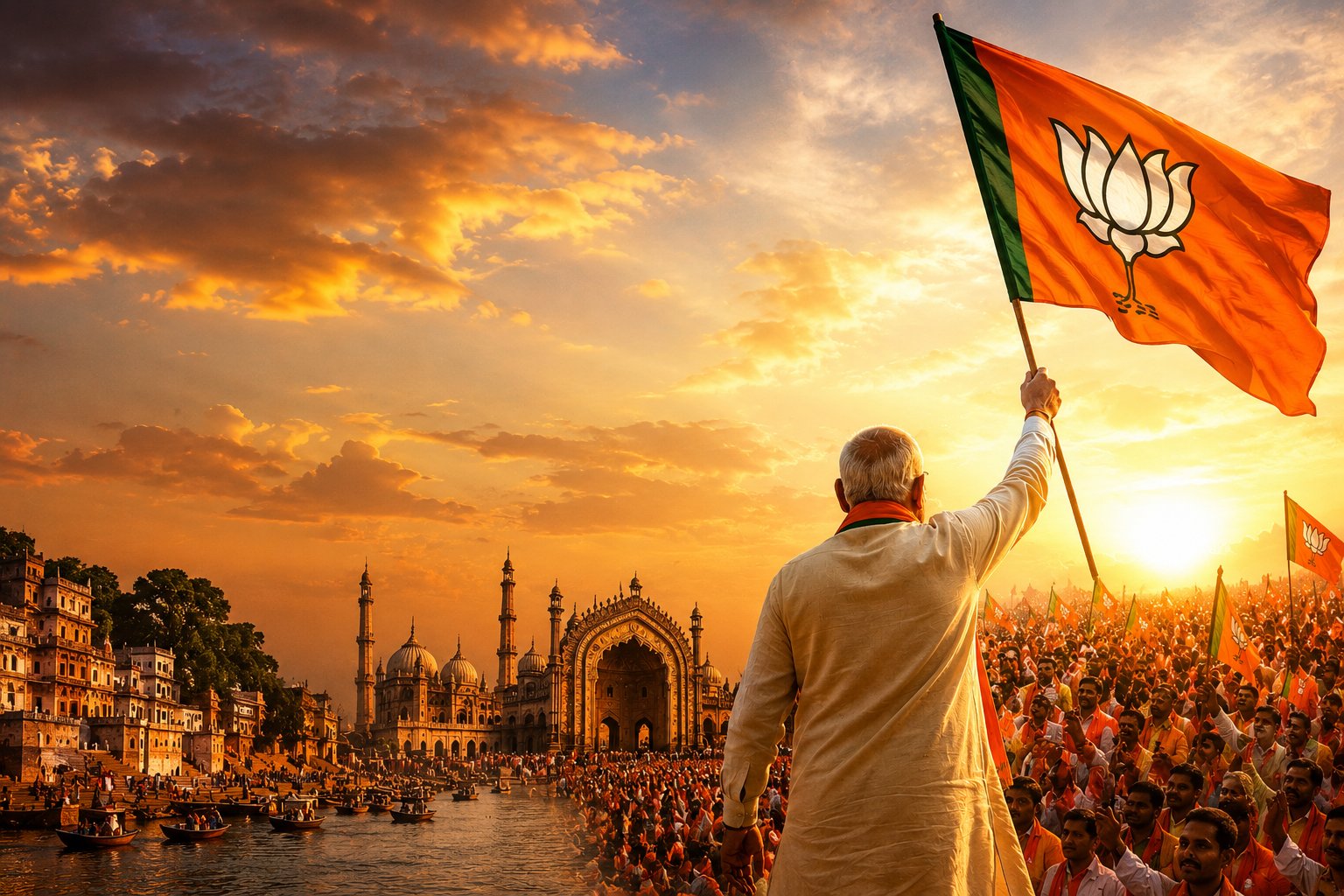
The Saffron Renaissance: How the BJP Rewrote the Political Geography and Social Grammar of Uttar Pradesh
For decades, political commentators viewed Uttar Pradesh through a fixed, immutable lens. It was a land where the grammar of power was dictated by rigid caste equations, where regional satraps held sway over fragmented fiefdoms, and where the national parties were increasingly relegated to the margins of history.
The conventional wisdom was clear: to rule Lucknow, one had to master the delicate, often volatile, arithmetic of identity politics. The Bharatiya Janata Party (BJP), long pigeonholed as a urban, upper-caste enclave—derided by critics as a “Brahmin-Baniya” party—seemed structurally incapable of breaking through the deeply entrenched fortresses of the Samajwadi Party (SP) and the Bahujan Samaj Party (BSP).
Yet, over the last nine years, a political transformation of historic proportions has unfolded across India’s most populous state. The BJP has not merely won elections; it has fundamentally dismantled the old political order and reconstructed it in its own image. By blending an unapologetic cultural narrative with an efficient, caste-transcending welfare apparatus, the party has achieved an unprecedented level of political dominance. Today, its footprint spans the entirety of the state’s diverse landscape, stretching from the bustling, high-tech corridors of Noida in the far west to the historic terrains of Siddharthnagar and Khalilabad in the east, and down to the rugged, long-neglected expanses of Jalaun and Mahoba in Bundelkhand. This article explores the structural shifts, strategic leadership, and grassroots engineering that have propelled the BJP from a secondary player to the undisputed hegemon of Uttar Pradesh.
From Mandal to Moditva: Dismantling the Old Caste Hegemonies
The modern political history of Uttar Pradesh was long defined by the post-Mandal era, a period that saw the rise of powerful regional parties built on specific, cohesive community vote banks. The Samajwadi Party found its core strength in a formidable combination of Yadavs and Muslims, while the Bahujan Samaj Party mobilized a highly disciplined Dalit base, particularly among Jatavs. For years, these combinations created an electoral see-saw, leaving the BJP on the sidelines.
The turning point came with a profound shift in organizational strategy. Recognizing that it could not breach the core strongholds of its rivals head-on, the BJP executed a masterclass in sub-categorized social engineering. The party turned its attention to the vast, fractured matrix of communities that felt marginalized by the dominant regional regimes. It reached out systematically to Non-Yadav Other Backward Classes (OBCs)—such as the Kurmis, Koeris, Mauryas, Lodhs, Rajbhars, and Nishads—and Non-Jatav Dalits, including the Pasis, Khatiks, and Balmikis.
By giving these underrepresented groups a significant share of organizational power, party tickets, and administrative representation, the BJP convinced them that their aspirations were aligned with its national vision. This strategy effectively decoupled the broader OBC and Dalit cohorts from their traditional leadership, shattering the old caste alliances and replacing them with a vast, multi-layered social coalition that transformed the state’s electoral dynamics.
The Cartography of Hegemony: Mapping a Pan-State Footprint
Uttar Pradesh is not a homogeneous entity; it is a mega-state comprised of distinct sub-regions, each with its own unique economic realities, cultural nuances, and historical grievances. Historically, political parties were dominant only within specific geographies. Western UP, with its agrarian wealth, was the playground of farm unions and community-specific satraps; Central UP was an SP stronghold; Eastern UP (Purvanchal) was fragmented along complex local fault lines; and Bundelkhand remained an impoverished afterthought.
The BJP’s greatest structural achievement over the past nine years has been the erasure of these regional boundaries to establish a truly pan-state presence.
THE PAN-UTTAR PRADESH FOOTPRINTWESTERN UP CENTRAL UP EASTERN UP (PURVANCHAL)
│ (Noida, Meerut) (Kanpur, Awadh Siddharthnagar, Khalilabad) │
│ Industrial Hubs Traditional Hubs Historical and Cultural Centres
Western UP: In the west, the party bridged the gap between rapid industrialization in districts like Noida and Ghaziabad and the rural agrarian economy. By addressing critical concerns around law and order and rural infrastructure, it built a durable voter base that withstood intense localized opposition.
Eastern UP and Bundelkhand: In Purvanchal, the party brought districts like Siddharthnagar and Khalilabad into the mainstream of developmental discourse. In the arid tracts of Bundelkhand, encompassing Jalaun and Mahoba, the BJP addressed long-standing water scarcity through targeted irrigation projects and the Bundelkhand Expressway, converting historical neglect into rock-solid electoral loyalty.
The Urban-Rural Confluence: From the intellectual and spiritual hubs of Allahabad (Prayagraj) and Varanasi to remote rural pockets, the party established a uniform presence, ensuring its organizational machinery was equally active in every corner of the stat
The Architecture of Governance: Balancing Elite Inclusion and Grassroots Empowerment
At the heart of the BJP’s sustained dominance in Uttar Pradesh is a carefully calibrated model of governance that mirrors its social coalition. The state administration successfully projects an image of inclusive power-sharing, balancing traditional influential communities with rising grassroots leaders.
Inclusive Governance Model
The cabinet and party structure reflect this deliberate equilibrium. Traditional upper castes, including Brahmins and Rajputs, continue to hold significant administrative portfolios, reassuring the party’s foundational voter base. Simultaneously, leaders from backward and Dalit communities have been elevated to pivotal executive positions, ensuring they have a tangible stake in the running of the state.
This inclusive approach has transformed public perception. The old criticism that the party served only elite urban interests has been thoroughly disproven. By building a governance structure where a village-level worker from an ordinary background can rise to influence policy alongside established political figures, the BJP has democratized its appeal, creating a robust framework capable of absorbing internal pressures and maintaining external dominance.
The Rise of the Labharthi: Transcending Social Divides Through Welfare
While strategic identity alignments provide a strong foundation, the true glue holding the BJP’s massive voter base together is the creation of a new socio-economic class: the Labharthi, or beneficiary. Over the last nine years, the state and central governments have engineered a welfare delivery system characterized by direct, unmediated benefits that bypass traditional local middlemen.
THE WELFARE DELIVERY ECOSYSTEM
This welfare ecosystem operates with high administrative efficiency. Millions of families across Uttar Pradesh have received concrete assistance, including subsidized housing grants, direct cash transfers into bank accounts, LPG cylinders, and clean tap water connections. During periods of global economic disruption, the continuous supply of free rations provided a critical safety net for rural households.
Crucially, this system operates on a principle of saturation, delivering aid based on economic need rather than community background. By ensuring that benefits reach eligible households regardless of caste, the party has successfully built a loyal constituency among low-income voters. This direct relationship between the state and the citizen has largely decoupled welfare from old caste loyalties, creating a shared sense of upward mobility among diverse groups.
A Subtle Realignment: The Shifting Horizons of Minority Engagement
One of the most complex aspects of the BJP’s evolution in Uttar Pradesh is its changing dynamic with the state’s substantial minority population. For a long time, conventional political analysts assumed a total barrier between the party and minority voters. However, recent years have seen a subtle but perceptible shift, driven by pragmatic administrative outreach and targeted welfare engagement.
A key element of this transition is the party’s focus on the Pasmanda community—the socio-economically backward sections within the minority population who historically reaped few rewards from traditional regional patronage networks. By highlighting that universal welfare initiatives like public housing and food security are delivered without discrimination, the BJP has addressed the day-to-day material concerns of these families.
Furthermore, a strong administrative focus on public safety and the suppression of local criminal syndicates has resonated with ordinary citizens, including small business owners within minority communities who benefit from a stable economic environment. While deep political divisions remain, the absolute polarization of the past has softened, replaced by a practical accommodation based on governance outcomes and economic stability.
The Vanguard of the Nation: Uttar Pradesh as the Anchor of the Indian Polity
The transformation of Uttar Pradesh cannot be viewed in isolation; it is the vital anchor of the BJP’s wider dominance across the geographical map of India. As the country’s largest political arena, sending eighty members to the national parliament, UP has historically decided the political trajectory of the nation. By securing a firm, long-term grip on Lucknow, the BJP established a powerful foundation for its national governance model.
The state has evolved from an economically lagging region into a primary driver of the national developmental agenda. Massive infrastructure investments, including network expressways, international airports, and dedicated industrial corridors, have repositioned UP as a premier investment destination. The state’s administrative methods—combining strict law enforcement with rapid infrastructure execution—now serve as a template for other regional administrations across the country.
Ultimately, the BJP’s journey in Uttar Pradesh over the last nine years is a story of profound institutional adaptation. By expanding its social identity, creating an efficient and inclusive welfare system, and establishing a uniform presence across every district from Noida to Siddharthnagar, the party has moved beyond traditional political paradigms. It has redefined the relationship between identity, governance, and development, creating a resilient political model that continues to shape the future of Indian democracy.