


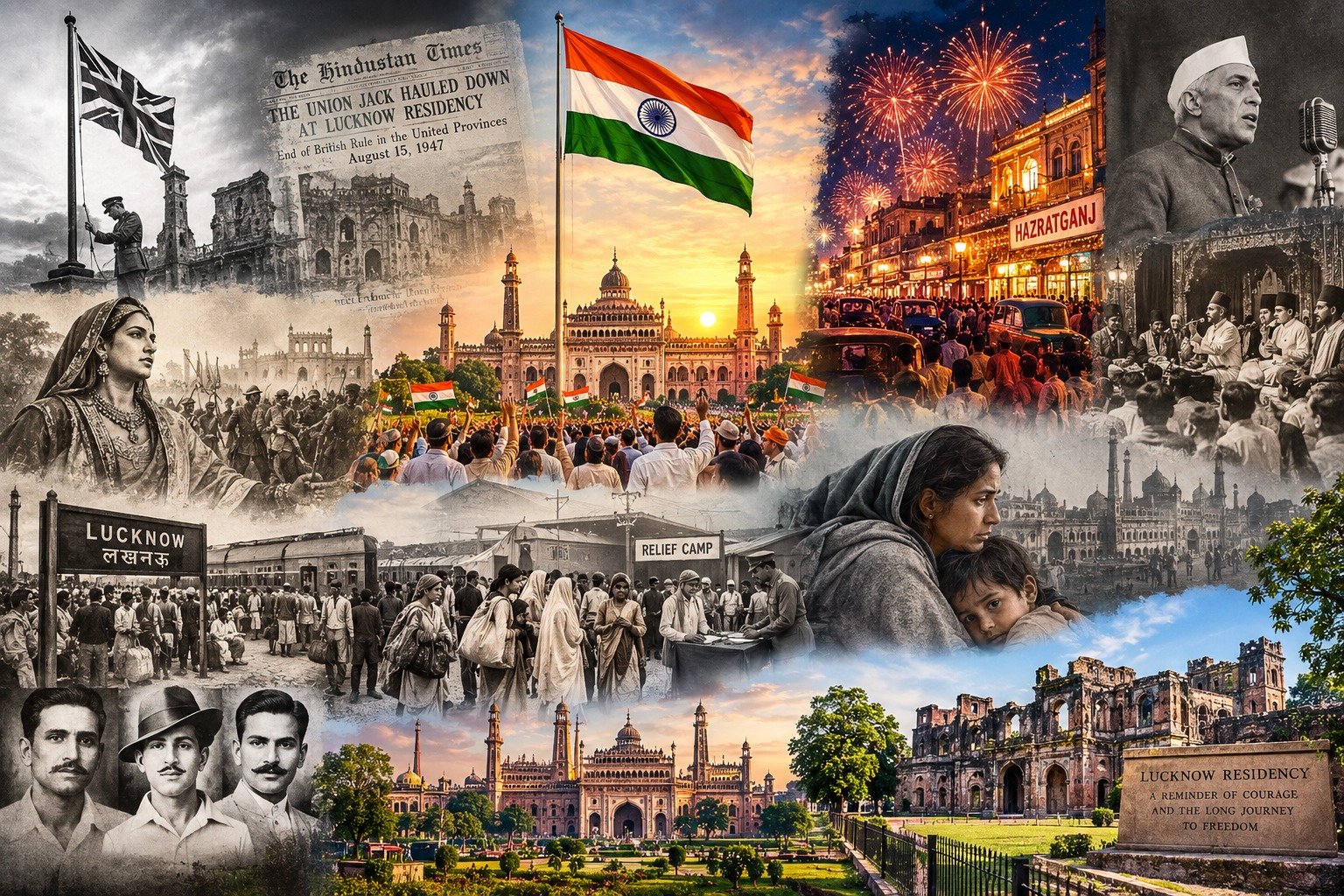
August 15, 1947, stands as the greatest focal point in modern Indian history, marking the end of nearly two centuries of British imperial dominance. Across the subcontinent, the dawn of freedom arrived as a long-awaited triumph. For the historic city of Lucknow—the heart of Awadhi culture and a crucible of the freedom struggle—this historic moment was a complex tapestry of euphoric celebration, deep generational scars, and the sudden, painful fractures of Partition.The transition of power transformed the city from a strategic capital of colonial administration into a foundational pillar of an independent democratic republic.
The Symbolic Fall of the Raj
For the British Empire, Lucknow held a deeply entrenched, psychological significance. Following the Indian Uprising of 1857, the British had established a unique tradition at the Lucknow Residency: flying the Union Jack 24 hours a day, never lowering it, as a symbol of permanent colonial dominance.That defiance came to a quiet end on the night of August 14, 1947. In a tightly guarded, private military ceremony, British officials lowered the flag for the final time. To ensure that no other nation’s flag could occupy the same spot, British engineers chopped down the flagpole, dismantled its base, and cemented over the ground.The Hindustan Times reported at the time, “The only Flag in the British Empire which has never been lowered since 1857 the Union Jack fluttering on Lucknow Residency was hauled down last night, about 24 hours before the transfer of power…”
The departure of Sir Francis Wylie, the final British Governor of the United Provinces, officially closed a chapter of foreign occupation.Midnight Euphoria: How Lucknow CelebratedAs the clock struck midnight, the city shed its colonial anxiety and erupted into massive public celebrations. The streets of Hazratganj, Aminabad, and Chowk filled with citizens waving the new Indian tricolour, setting off fireworks, and distributing traditional sweets.The Raising of the Tricolour: Official buildings, including the Council House, replaced colonial emblems with Indian national symbols.Mass Congregations: Thousands of residents gathered in public squares to listen to loudspeakers broadcasting Jawaharlal Nehru’s iconic “Tryst with Destiny” speech from New Delhi.Cultural Intersections: Mushairas (poetry gatherings) and public speeches filled the night as local artists, poets, and musicians celebrated the birth of a sovereign nation.
The Shadow of Partition
Lucknow’s joy was quickly met by the grim realities of the Partition of India. The division of the subcontinent forced millions of people across newly drawn borders amidst a wave of communal violence.
August 15, 1947: Independence
Midnight Celebrations Mass Migration Violence
– Flag hoistings – Influx of Punjabi/Sikh refugees
– Public poetry and mushairas – Departure of Awadhi Muslim elite
– End of British administration Fractured families and ancestral homes
While Lucknow escaped the extreme physical violence seen in Punjab and Bengal, the social and cultural impact of Partition was profound.
1. The Human Influx and RefugesTens of thousands of Hindu and Sikh refugees fleeing West Punjab arrived at the Lucknow Railway Station. Entire families had abandoned their ancestral properties with nothing but their lives. The local administration and civil society quickly shifted from hosting celebrations to managing relief camps, processing rehabilitation requests, and setting up new commercial markets to help displaced families rebuild their livelihoods.
2. The Cultural FracturePartition struck at the heart of Lucknow’s composite Ganga-Jamuni tehzeeb (the historic synthesis of Hindu and Muslim cultures). Families were abruptly divided. A significant portion of Lucknow’s educated Muslim professional elite, writers, and artists chose or felt compelled to migrate to Pakistan. This migration left historic neighborhoods hollowed out, permanently altering the demographic, linguistic, and cultural fabric of the old city.Lucknow’s Legacy in the Freedom StruggleTo understand Lucknow on August 15, 1947, one must remember its long, revolutionary path to that moment. The city was never a passive observer of colonial rule; it was a primary center of resistance.
The Crucible of 1857: During the Great Uprising, Lucknow was the center of anti-colonial resistance. Begum Hazrat Mahal, alongside local sepoys and peasants, successfully besieged the British Residency for months, demonstrating an early, unified defiance against East India Company rule.The 1916 Lucknow Pact: Decades later, the city hosted the historic 1916 joint session of the Indian National Congress and the All-India Muslim League. The resulting Lucknow Pact temporarily united moderate and extremist factions alongside Muslim leadership, presenting a joint demand for self-governance to the British.The Kakori Train Robbery (1925): Just on the outskirts of Lucknow, revolutionaries from the Hindustan Republican Association (including Ram Prasad Bismil and Ashfaqullah Khan) raided a colonial train.
The subsequent high-profile trials inside Lucknow became a major rallying point for youth nationalism across India.A Long Journey: From Capital of Oudh to Modern EraLucknow’s transition on August 15, 1947, was a hard-fought evolution from an occupied royal territory to a democratic provincial capital. The city evolved from the courtly opulence of the Nawabs, survived the destructive retributions of post-1857 British rule, and emerged as a vital political anchor for independent India.When the tricolour rose over the city in August 1947, it carried the weight of both a historic victory and the quiet grief of a fractured region. Today, the preserved, battle-scarred ruins of the Lucknow Residency stand not as a monument to colonial triumph, but as a permanent reminder of the long journey the city took to achieve its freedom.